

In 2026, everything costs more. I get it. When you’re standing at the counter and the service advisor tells you a “Premium Synthetic” oil change is $95, while the “Basic Conventional” is only $55, it’s tempting to save the $40.
You might ask yourself: “It’s just oil, right? Is the expensive stuff just marketing hype?”
As a mechanic who rebuilds engines that failed because of cheap oil, let me give you the honest truth: For 95% of cars on the road today, synthetic oil is not optional. It’s an insurance policy.
Saving $40 today could cost you $8,000 in a new engine tomorrow. Here is the engineering reality of why synthetic oil is worth every penny.
1. The Science: It’s “Liquid Engineering,” Not Just Oil
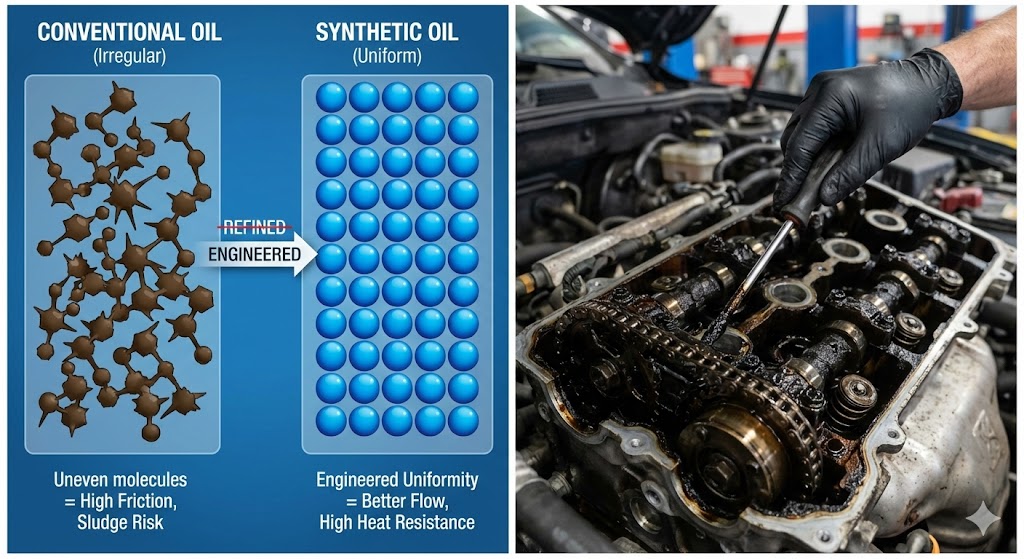
Think of conventional oil like tap water from a muddy river. It gets filtered, but it’s still inconsistent. It contains impurities like sulfur and wax that sludge up when hot and turn into molasses when cold.
Synthetic oil is like distilled water created in a lab.
It is chemically engineered molecule by molecule to be perfect. Every molecule is the exact same size. This is crucial for two reasons:
Extreme Cold Flow: In freezing temperatures, conventional oil turns thick and can take 30 seconds to reach the top of your engine on startup. That’s 30 seconds of metal-on-metal grinding. Synthetic oil flows immediately, protecting your engine from second one.
Extreme Heat Resistance: Modern engines, especially turbocharged ones, run incredibly hot. Conventional oil literally burns off and turns into hard carbon deposits (sludge) inside your turbo. Synthetic oil can withstand temperatures over 400°F without breaking down.
WATCH: Engineering Explained: Why Synthetic Wins
Don’t believe me? Watch mechanical engineer Jason Fenske explain the undeniable science behind why synthetic oil is vastly superior.
2. Why Modern Engines Will DIE on Conventional Oil
If you drive a car built after 2015, especially one with a turbocharger (like a Ford EcoBoost, Honda 1.5T, or VW/Audi), you cannot use conventional oil.
Here is why:
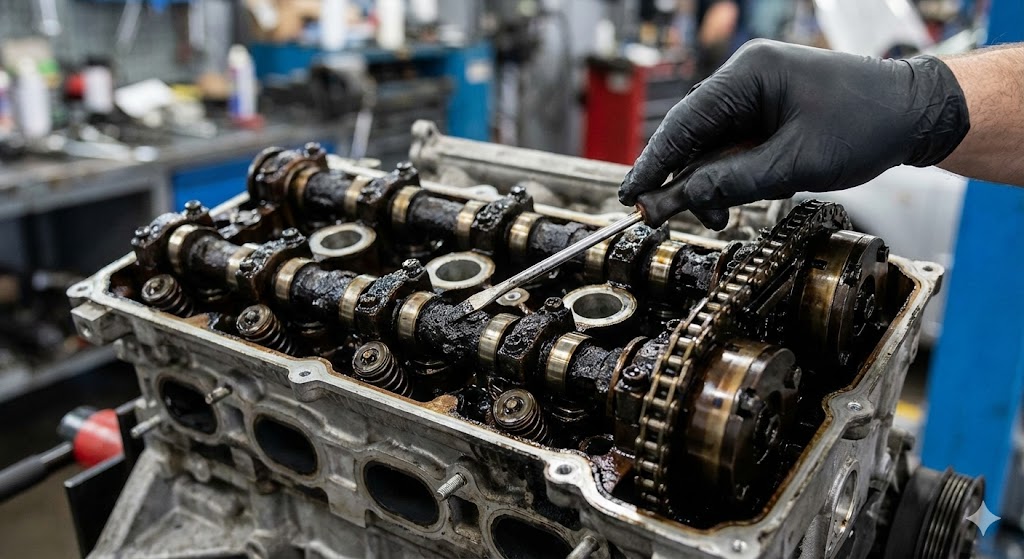
Turbochargers: The bearing inside your turbo spins at 200,000 RPM and gets red-hot. After you turn your car off, heat soaks into the oil. Conventional oil will “coke” (turn into solid charcoal), clogging the turbo’s oil line. A new turbo costs $2,500+.
Timing Chains: Modern engines use long timing chains kept tight by hydraulic tensioners that use oil pressure. Dirty, thick conventional oil clogs these tensioners. The chain gets loose, “jumps” time, and destroys your pistons and valves. A new engine costs $8,000+.
Low-Speed Pre-Ignition (LSPI): This is a phenomenon where fuel ignites too early in small turbo engines, causing catastrophic engine failure. Modern synthetic oils (API SP / GF-7 spec) have specific chemical additives engineered to prevent LSPI. Conventional oil does not.
3. The Price Math: Synthetic is Actually Cheaper
This is the part that blows people’s minds. Synthetic oil costs more upfront, but it lasts twice as long.
Scenario A: The “Cheap” Guy
Uses Conventional Oil ($55 per change)
Must change it every 4,000 miles (it breaks down fast)
Over 12,000 miles: 3 oil changes x $55 = $165
Risk: High risk of sludge and engine wear.
Scenario B: The “Smart” Guy
Uses Full Synthetic Oil ($95 per change)
Changes it every 8,000 – 10,000 miles (safely)
Over 12,000 miles: 1.5 oil changes = ~$142
Benefit: Superior engine protection and a valid warranty.
Conclusion: Over the life of the car, synthetic oil is actually cheaper because you change it less often, and you avoid massive repair bills.
Final Verdict: When Can You Cheap Out?
Is there ever a time to use conventional oil? Yes.
If you drive a 1998 Ford F-150 with 250,000 miles that burns a quart of oil every week, go ahead and use the cheap stuff. It’s going to leak or burn it anyway.
But if you drive a 2022 Honda CR-V, a 2024 Ford Explorer, or literally any modern car that you plan to keep for more than two years, synthetic oil is mandatory. It’s not an upsell; it’s a requirement for modern engineering.
Pay the extra $40 now. Your future self will thank you. It’s the best insurance policy you can buy for your engine.
In fact, for many of you reading this, it’s not even a choice. Modern engineering demands it. To see if your specific vehicle falls into the mandatory category, check out my article: Which cars actually need full synthetic oil?.


