
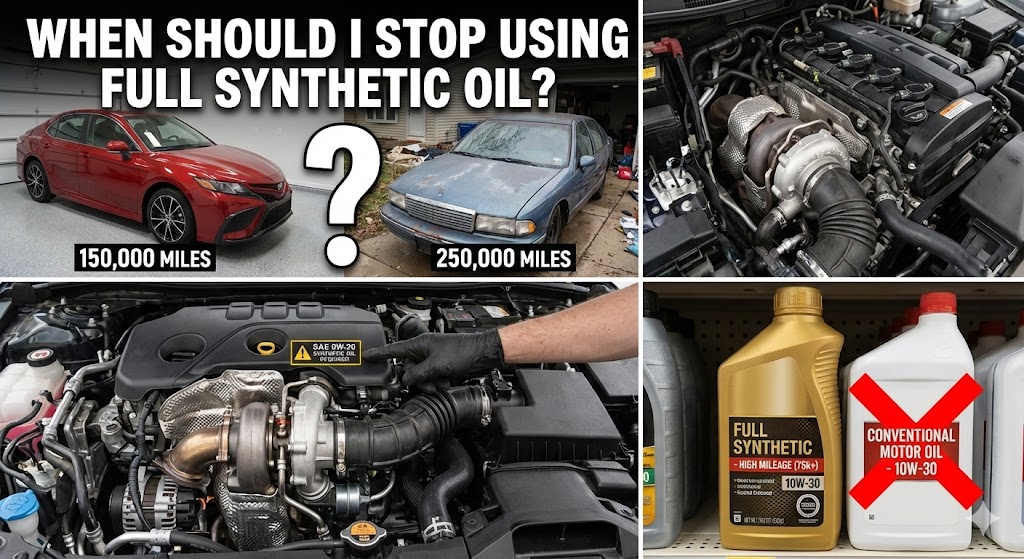
It’s a scenario I see constantly at the shop. A customer has been diligently using full synthetic oil in their Honda Accord since it was brand new. Now, the odometer just rolled over 150,000 miles. The paint is fading, and the trade-in value is dropping.
They look at the $120 bill for premium service—and knowing how expensive a full synthetic oil change actually is in 2026—they ask me the question:
“Dave, the car is old now. Should I stop using the expensive synthetic stuff and switch back to cheaper conventional oil? Isn’t synthetic bad for old engines?”
It’s a fair question that balances automotive mythology with financial reality.
Here is my honest mechanic’s verdict on when you should—and absolutely should not—stop using synthetic oil.
The Great “High Mileage Leak” Myth
Let’s kill the biggest zombie myth in automotive history right now.
Myth: Once an engine gets old, synthetic oil is “too slippery” and will find its way past old gaskets, causing massive oil leaks that wouldn’t happen with conventional oil.
Reality in 2026: This hasn’t been true for over 30 years.
In the 1970s, early synthetic formulations did sometimes shrink engine seals. But modern synthetic oils contain advanced seal-swelling agents designed to keep gaskets pliable.
If your engine starts leaking after switching to synthetic, it’s not because the oil caused the leak. It’s because you already had a cracked, dried-out seal, and the synthetic oil cleaned out the gunk that was temporarily plugging the hole.
The only real disadvantage of synthetic oil today is the price tag, not its effect on old seals.
When You Absolutely MUST NOT Stop Using Synthetic
For the vast majority of cars built after 2010, “stopping” synthetic isn’t an option, regardless of mileage.
If your car is on the list of vehicles that actually need full synthetic oil, that requirement doesn’t expire when you hit 100k miles.
Do not downgrade if:
You have a Turbo: An old turbo gets just as hot as a new one. Conventional oil will cook inside the bearing and kill the turbo fast.
Your engine requires thin viscosity (0W-20): You can’t buy conventional oil in these thin specs anyway.
Downgrading a high-tech engine to conventional oil just because it’s old is like stopping healthy eating just because you turned 60. It’s the exact moment you need more protection, not less.
The ONE Exception: The “Terminal” Oil Burner
Okay, here is the honest mechanic’s truth where finance trumps engineering. There is one specific scenario where I tell customers to stop wasting money on synthetic.
The Scenario: You have a 2008 “beater” car worth $1,500. It runs okay, but it burns or leaks a quart of oil every 500 miles. You are just trying to limp it along for another six months until it dies.
In this specific “hospice care” situation, pouring $10 a quart synthetic into an engine that is just going to burn it out the tailpipe next week is financial nonsense.
As I’ve explained before, you can switch back and forth between synthetic and regular oil safely. If the car is “terminal,” buy the cheapest conventional oil in a 5-quart jug and keep it topped off. It won’t fix the engine, but it will save your wallet while you wait for the inevitable end.
The Better Alternative: “High Mileage” Full Synthetic
If your car isn’t a “beater,” but is just getting up there in miles (over 75,000), don’t downgrade to conventional. Switch sideways to a “High Mileage” Full Synthetic.
These oils are fantastic. They are premium synthetic bases loaded with extra additives specifically for aging engines:
Seal Conditioners: Extra chemicals to soften hardened gaskets and slow down minor weeps.
Extra Detergents: To clean out sludge that accumulated over the last decade.
Anti-Wear Additives: A thicker film to protect worn bearings.
Dave’s Bottom Line: Unless your car is literally ready for the junkyard, keep using synthetic. We know that engines last longer with synthetic oil. Sticking with the good stuff is the best way to ensure your 150,000-mile car makes it to 250,000 miles.


