
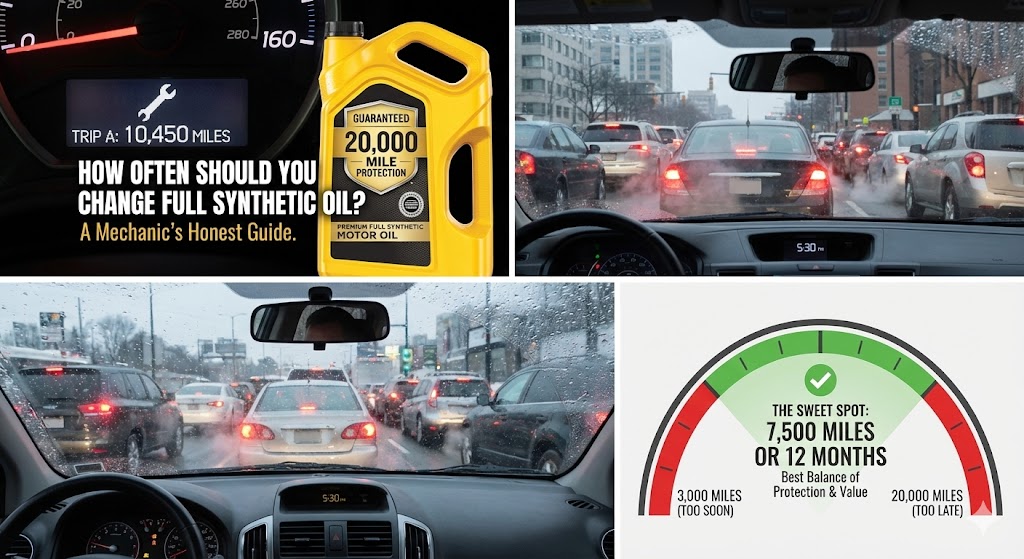
If you are confused about when to change your oil in 2026, I don’t blame you.
Your dad swears by the old “every 3,000 miles” rule. The bottle of premium synthetic oil on the shelf at AutoZone says it lasts for “20,000 miles.” Your car’s dashboard computer tells you something else entirely.
Who is telling the truth?
As a mechanic who sees the insides of engines every day, I can tell you this: The 3,000-mile rule is dead, but the 20,000-mile promise is a dangerous gamble.
Modern 2026 synthetic oils are incredible pieces of chemical engineering, but they aren’t magic. They still get dirty. They still get diluted by fuel.
Here is the honest truth about finding the “sweet spot” interval that protects your expensive engine without wasting money on unnecessary changes.
1. The Death of 3k vs. The Hype of 20k
Let’s clear the air on the extremes.
The 3,000-Mile Myth: This rule existed when cars used crude conventional oil and carburetors that dumped raw fuel into the crankcase. In 2026, with modern fuel injection and API SP/GF-7 certified synthetic oil, changing your oil at 3,000 miles is just pouring money down the drain. It’s wasteful.
The 20,000-Mile Hype: You see this on marketing labels. Can that oil theoretically last 20k miles in a lab test under perfect conditions? Yes. Does your daily commute in stop-and-go traffic resemble a lab test? No. Waiting 20,000 miles is begging for sludge buildup in a modern turbocharged engine.
2. The “Severe Service” Trap (You Are Probably In It)
This is the most important part of this article. Open your owner’s manual. You will usually see two maintenance schedules: “Normal” and “Severe” (sometimes called “Special”).
Here is the secret manufacturers don’t advertise: Almost everyone drives under “Severe” conditions.
To qualify for the “Normal” (long) interval, you basically need to drive 50 miles on a highway at 65mph every time you turn the key, in 70°F weather, with no hills.
You are in the “Severe” category if you:
Take short trips (under 10 miles) where the engine doesn’t fully warm up.
Drive in stop-and-go city traffic.
Drive in freezing cold or extreme heat (over 90°F).
Idle a lot (waiting to pick up kids, sitting in drive-thrus).
Tow or haul heavy loads.
Have a turbocharged engine (which cooks oil faster).
If you fit any of those criteria, you need to cut the manufacturer’s maximum recommended interval in half.

WATCH: Why Short Trips Kill Your Oil Faster
Engineering Explained breaks down why driving 5 minutes to the grocery store is actually harder on your oil than driving 500 miles on the highway.
3. Trusting the Computer (Oil Life Monitors)
Most cars built in the last decade don’t have a set mileage reminder; they have an “Oil Life Monitor” (OLM) that counts down from 100% to 0%.
How they work: Most are flawed algorithms. They track engine revolutions, temperature, and time. They do not actually analyze the physical oil in your engine.
The Mechanic’s Take: OLMs are better than dumb mileage counters, but they are often too optimistic. They are programmed by manufacturers who want to advertise “low cost of ownership.”
If your dashboard says you have 15% oil life left, change it now. Do not wait for 0%. I’ve torn apart too many sludged-up engines where the owner said, “But the computer said I still had 5% left!”
4. Dave’s Final Verdict: The Magic Number
So, if 3,000 is too soon, 20,000 is too late, and the computer is too optimistic, what is the answer?
For a modern vehicle (2018-2026) using high-quality Full Synthetic oil, driven in typical mixed American conditions (which we established is “Severe”), here is my professional recommendation:
The Sweet Spot: Every 7,500 Miles or 12 Months
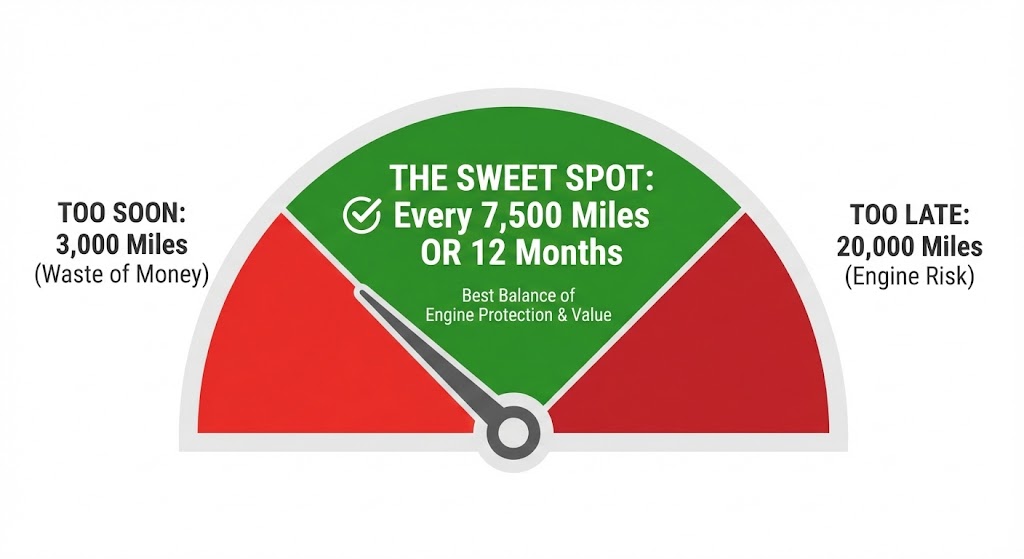
(Whichever comes first)
This interval is the perfect balance. It maximizes the useful life of expensive synthetic oil while providing a safe buffer against sludge and fuel dilution.
If you have a high-performance turbocharged car or do heavy towing, drop that to 5,000 miles.
Oil is cheap. Engines are expensive. Don’t try to set a world record for the longest oil change interval.
WATCH: A Toyota Master Tech on 10k Mile Intervals
Listen to The Car Care Nut (a highly respected Toyota Master Diagnostic Technician) explain why he never recommends following the manufacturer’s 10,000-mile interval if you want your car to last long-term.


