
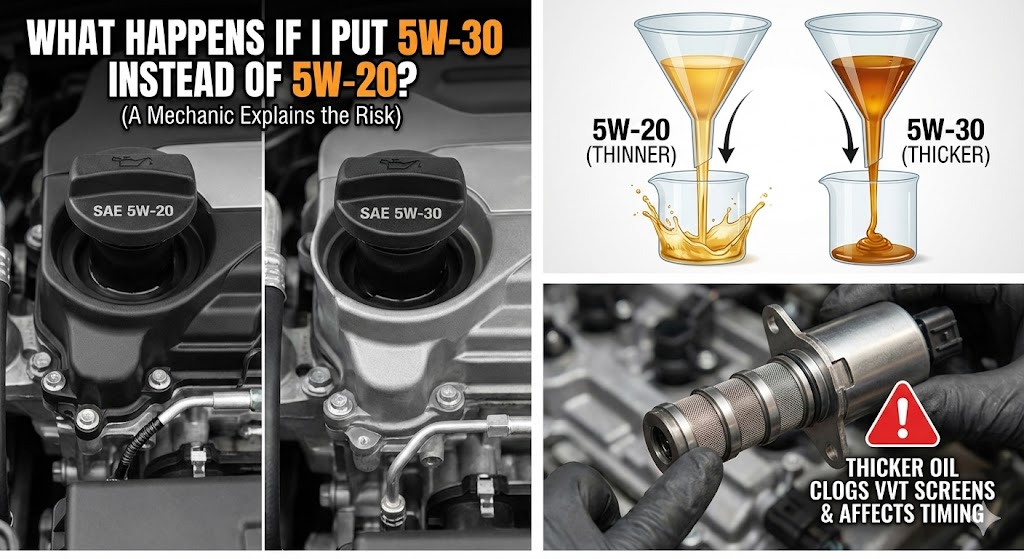
It’s a moment of panic. You’re topping off your oil in the AutoZone parking lot, you pour in a quart, and then you look at the bottle again. It says 5W-30. You look at your oil cap. It says 5W-20.
Or maybe you just got your oil changed at a quick-lube place, and the sticker on your windshield lists the wrong viscosity number.
Your stomach drops. Did you just ruin your engine? Will it seize up on the way home?
As a mechanic, I get this panicked phone call a lot. Here is the honest truth right up front: No, your engine will not immediately blow up.
But that doesn’t mean it’s okay to do it long-term. In the high-tech automotive world of 2026, those little numbers mean a lot more than they used to. Here is exactly what happens inside your engine when you use thicker oil than recommended.
1. The Basics: What’s the Difference Between 20 and 30?
Let’s keep this simple. The numbers refer to oil “viscosity,” which is just a fancy word for thickness.
The “5W”: This stands for “Winter.” Both oils act the same when cold. They are both thin enough to let the engine turn over easily on a freezing morning.
The “20” vs. “30”: This is the thickness of the oil once your engine is fully warmed up (around 212°F). 5W-30 is thicker than 5W-20 at operating temperature.
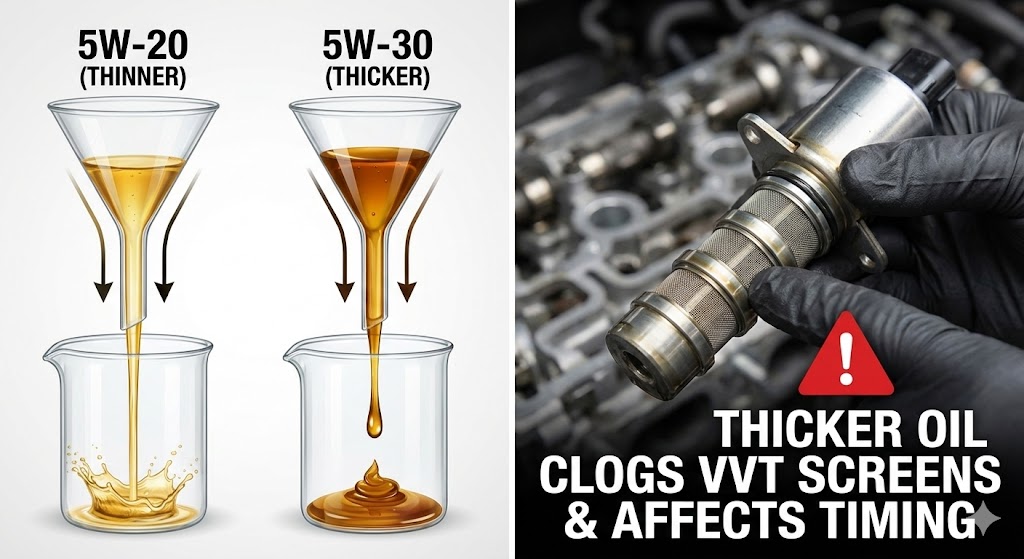
Think of it like syrup. 5W-20 is like warm maple syrup; it flows fast. 5W-30 is slightly cooler syrup; it flows a bit slower.
2. The Short Term: Will It Hurt Just Once?
If you accidentally used 5W-30 for one oil change, or topped off a quart in an emergency, don’t panic.
In the short term, you will likely notice absolutely nothing. Your car won’t make funny noises, and check engine lights won’t instantly pop on.
Much like the question of switching back and forth between synthetic and regular oil, doing it once in a pinch isn’t catastrophic. Having any CLEAN oil in the engine is always better than having low or dirty oil.
However, you might see a tiny drop in fuel economy (maybe 1-2%). Because the oil is thicker, the oil pump has to work slightly harder to push it around, which wastes a little bit of energy.
3. The Long Term Risk: Why Modern Engines Hate Thick Oil
This is where the rubber meets the road in 2026. If you have an older truck from 2005, it probably loves 5W-30. But if you have a modern Honda, Toyota, or Ford designed for 5W-20 (or even 0W-20), using thicker oil long-term is a bad idea.
Modern engines are built with incredibly tight “tolerances”—the spaces between moving metal parts are microscopic.
Starvation at Startup: Even though they are both “5W,” the thicker 30-weight takes just a fraction of a second longer to squeeze into tight bearings. Over thousands of starts, that extra wear adds up.
Variable Valve Timing (VVT) Issues: This is the big one. Modern cars use oil pressure like hydraulic fluid to adjust engine timing on the fly for power and efficiency. These systems are calibrated specifically for the flow rate of thinner oil. Thicker 5W-30 moves too slowly through the tiny VVT screens and solenoids, causing sluggish performance and eventually triggering a Check Engine Light.
Cars that are on the list of which vehicles actually need full synthetic oil are particularly sensitive to having the correct viscosity.
WATCH: How Wrong Viscosity Affects Variable Valve Timing
This video gives a great technical explanation of how modern VVT systems use oil pressure and why using the wrong thickness can throw the whole system out of whack.
4. Dave’s Verdict: Don’t Outsmart the Engineers
There is an old-school myth that “thicker oil protects better,” especially in high heat. That used to be true in the 1980s. It is not true today.
The engineers who built your car spent millions of dollars testing to determine the exact perfect viscosity to balance protection, fuel economy, and VVT function.
The Bottom Line:
Did you do it by accident once? Don’t worry about it. Just change it back to the right stuff at your next scheduled interval.
Are you thinking of switching to 5W-30 permanently because you think it’s “better”? Don’t. You are risking long-term issues for zero benefit.
Open your hood, read the cap, and put in what it says. It’s that simple.


