
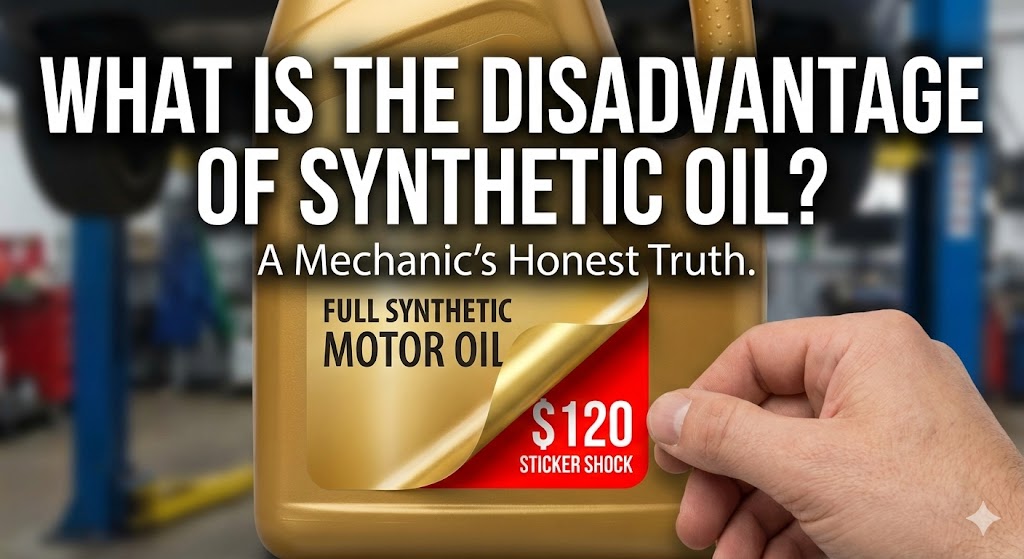
If you’ve read any of my other articles here in 2026, you know I’m a massive advocate for synthetic oil. For 99% of the cars on the road today—especially anything with a turbo—it’s liquid engineering that keeps your engine alive.
So, why would I write an article about its disadvantages?
Because as a mechanic who deals with real customers and their budgets every day, I know nothing is perfect. Even the best technology has a downside.
When customers ask me, “Dave, what’s the catch with this expensive oil?”, I give them the honest truth. There are two main disadvantages: one that hits your wallet immediately, and a hidden one that can hit your engine later if you aren’t careful.
Here is the breakdown.
1. The Obvious Disadvantage: The “Sticker Shock”
Let’s get the elephant in the room out of the way first.
The biggest and most immediate disadvantage of synthetic oil is the price.
In 2026, a 5-quart jug of quality full synthetic oil at an auto parts store costs anywhere from $35 to $60. A jug of old-school conventional oil? Maybe $25.
When you take your car to a shop, that difference gets magnified by labor and overhead.
Conventional Oil Change: ~$55 – $65
Full Synthetic Oil Change: ~$95 – $130+
For many families trying to balance a budget, that extra $40-$70 right now is a tough pill to swallow. It feels like an upsell.
But be careful before you switch to the cheap stuff. Before you try to save money by choosing conventional oil, you must verify if your engine requires the premium stuff to survive. Read my guide on which cars actually need full synthetic oil. Using the wrong oil to save $40 could cost you a $4,000 turbo.
Why does it cost more? You aren’t paying for dinosaur juice pulled from the ground. You are paying for a chemical engineering process that synthesizes base molecules in a lab, plus a complex additive package designed to fight modern engine problems like low-speed pre-ignition (LSPI). It’s expensive to manufacture perfection.
WATCH: Why is Synthetic Oil So Expensive to Make?
This video from Engineering Explained dives into the complex chemical process that makes synthetic oil superior, but also more costly to produce than refining crude oil.
2. The Hidden Risk: The “False Security” Trap
This is the disadvantage that actually worries me as a mechanic. It’s psychological.
Because synthetic oil is marketed as a miracle product that lasts for “15,000 or 20,000 miles,” many drivers develop a false sense of security.
The Trap: You pay $120 for a premium synthetic oil change. You see the “20k Mile Protection” on the sticker. So, you completely ignore your car’s hood for the next 18 months.
The Reality:
Oil Consumption: Modern engines, especially Subarus, Hondas, and Toyotas with low-tension piston rings, are designed to burn a small amount of oil. You might burn a quart every 3,000 miles. If you wait 15,000 miles without checking, your engine could be running dangerously low on oil, even if the remaining oil is still “good.”
The Filter Failure: The oil might theoretically last 20,000 miles, but most oil filters are not rated for that long. A clogged filter goes into “bypass mode,” circulating dirty, unfiltered oil through your engine.
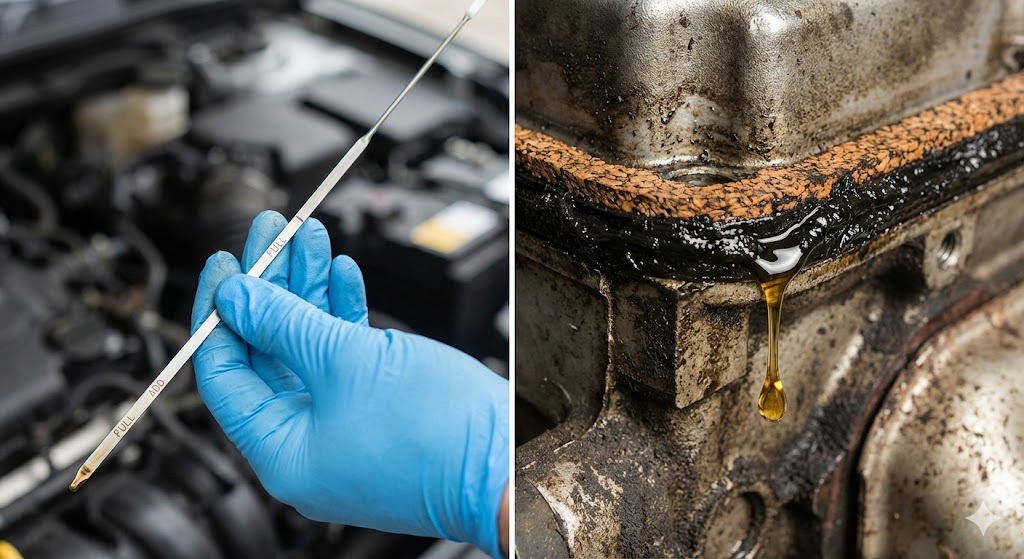
The synthetic disadvantage is that it makes people lazy about basic maintenance. You still need to pop the hood and check your dipstick every few gas fill-ups.
3. The Mythical Disadvantage: Does it Cause Leaks?
I have to include this because I still hear it every week, even in 2026.
“My grandpa said don’t put synthetic in an old car because it’ll cause leaks.”
This is practically a myth today.
In the 1970s, early synthetics did sometimes shrink engine seals. But modern synthetic oil formulations include swelling agents specifically designed to be compatible with gaskets.
If you put synthetic oil in an old, neglected engine and it starts leaking, the synthetic didn’t cause the leak. It cleaned out the thick, nasty sludge that was temporarily plugging an existing hole. It revealed a leak you already had.
WATCH: Fact or Myth: Synthetic Oil Causes Leaks
The experts at Summit Racing provide a definitive answer on whether modern synthetic oils are safe for seals and gaskets.
4. Final Verdict: Is the Downside Worth It?
So, the disadvantages are:
It costs more today.
It might tempt you to neglect checking your oil level.
Are those deal-breakers?
Not even close.
Think of the higher cost as the cheapest insurance policy you will ever buy. An extra $50 a year on oil is nothing compared to a $7,000 bill for a new turbocharged engine.
The only real danger is your own behavior. Use the best oil, but don’t forget the basics: Check your dipstick.


