
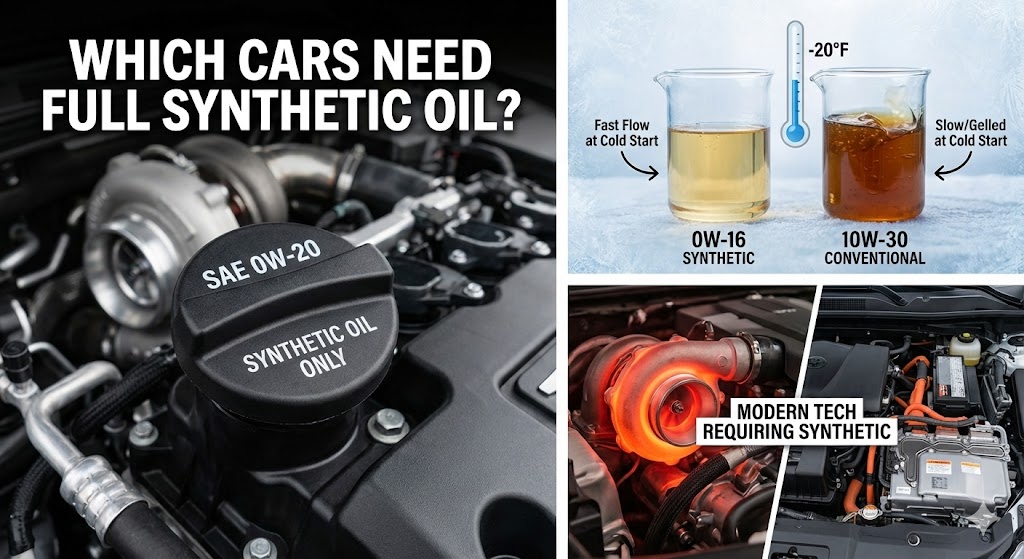
Walk into any auto parts store in 2026, and you’ll notice something: the “conventional oil” section is tiny. It’s tucked away in a corner, gathering dust.
Twenty years ago, synthetic oil was an expensive upsell for sports cars. Today, it is the baseline standard for the vast majority of vehicles on the road.
Yet, customers still ask me every day: “Dave, does my regular old commuter car really NEED that expensive synthetic stuff, or are they just trying to squeeze more money out of me?”
Here is the honest truth: If your car was built in the last 10-15 years, the answer is almost certainly YES.
It’s not about upselling; it’s about engineering. Modern engines are built tighter, run hotter, and require thinner oil than ever before. Using the wrong stuff isn’t a way to save money; it’s a slow way to kill your engine.
Here is the breakdown of which cars absolutely require full synthetic oil.
1. The Hard Rule: If It Has a Turbo, It Needs Synthetic
In 2026, it’s hard to find a car without a turbocharger. From basic Honda Civics to giant Ford F-150s, manufacturers use small engines with turbos to get both power and fuel economy.
A turbocharger spins at incredible speeds (up to 200,000 RPM) and gets red-hot. The only thing lubricating that spinning shaft is a thin film of engine oil.
Conventional oil cannot survive this heat. It literally fries into hard carbon deposits (coking) that clog the oil lines, killing the turbo. Synthetic oil can withstand temperatures over 450°F without breaking down.
If your car has a “T” on the back (1.5T, 2.0T, EcoBoost, etc.), synthetic oil is mandatory.
2. The Thin Oil Mandate (0W-20, 0W-16, 0W-8)
To meet strict government fuel economy standards, manufacturers have designed engines with incredibly tight tolerances that require water-thin oil to reduce internal friction.
Look at your oil cap. Does it say 0W-20? Or perhaps the even thinner 0W-16 or the ultra-thin 0W-8 common in 2026 Toyotas and Hondas?
You cannot make conventional oil that thin and still protect an engine. It’s chemically impossible. If your car requires a “0W” viscosity grade, it must be synthetic. Pouring thick, old-school 10W-30 conventional oil into a modern engine designed for 0W-16 will starve it of lubrication on startup and cause massive damage.
For a deeper dive into why these modern oils cost more to engineer, check out my article on if synthetic oil is really worth the extra cost.
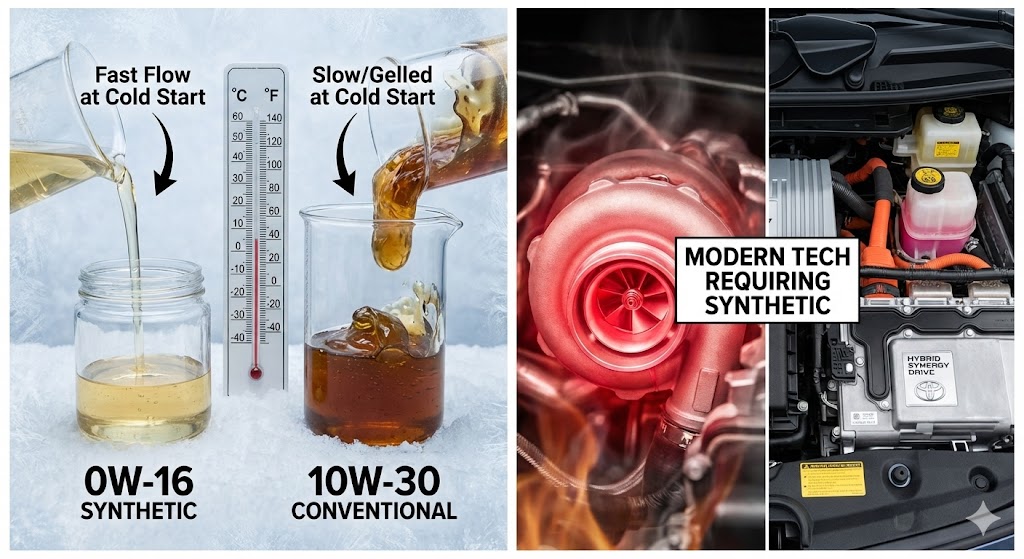
WATCH: How Turbos Destroy Conventional Oil
This is a great visual demonstration of why turbochargers require the high-heat resistance that only synthetic oil provides.
3. Hybrids and Start-Stop Vehicles
Does your engine shut off every time you come to a red light? Do you drive a Prius, RAV4 Hybrid, or any modern mild-hybrid?
These engines start and stop dozens of times during a single commute. Every time the engine starts, there is a moment where metal parts are moving before oil pressure builds up.
Synthetic oil leaves a stronger protective film on metal parts when the engine is off, and it pumps instantly when the engine restarts. Conventional oil is too slow to protect engines subject to constant start-stop cycles.
4. The “Transition Era” Cars (2000-2012)
This is where it gets tricky. Many cars built in this era—like a 2008 Toyota Camry or a 2005 Chevy Silverado—were originally sold when conventional oil was the standard. Their manuals might say conventional 5W-30 is “acceptable.”
The Mechanic’s Advice: Just because you can use conventional doesn’t mean you should.
These engines often have variable valve timing (VVT) systems with tiny oil screens that easily clog with sludge from conventional oil. While not strictly “required” by the manual, switching these older cars to high-mileage synthetic is the single best thing you can do to keep them running longer.
As I’ve written before, the evidence is clear that engines last significantly longer with synthetic oil.
Are there exceptions? Yes. There are a few specific types of older vehicles—like classic cars with flat-tappet cams or rotary engines—that actually do better with conventional oil. You can read about those rare exceptions in my guide on what cars should NOT use synthetic oil.
5. How to Know for Sure (Don’t Guess)
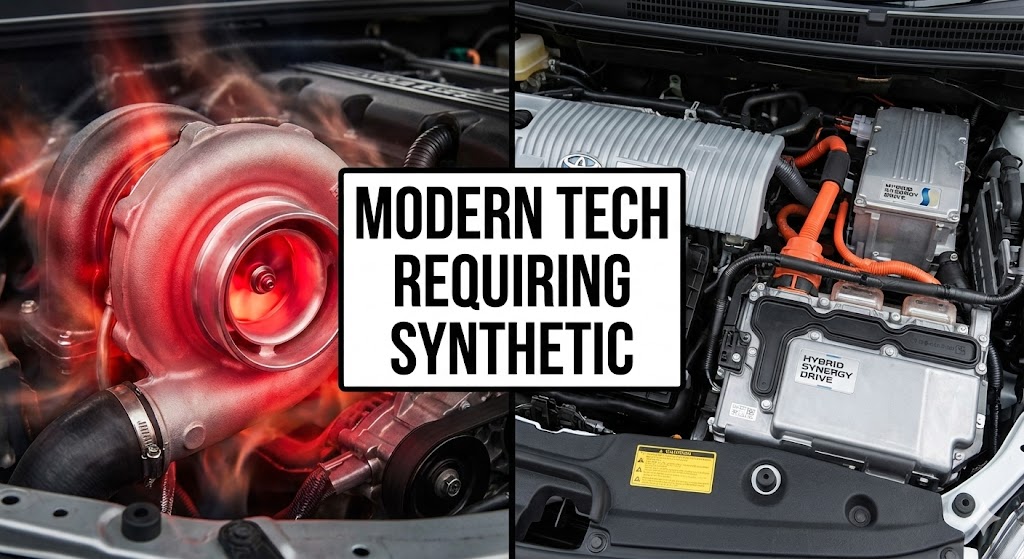
Don’t rely on what your dad used in his ’78 Buick. Here is how to know what your car needs in 2026:
Look at the Oil Filler Cap: On 90% of modern cars, the required oil type and viscosity are printed right on the cap under the hood (e.g., “SAE 0W-20 Synthetic Only”).
Check the Owner’s Manual: Look under the “Specifications” or “Maintenance” section. It will state the required oil standard (like API SP or ILSAC GF-7).
Final thought: If your car was built in the last decade, stop asking if you need synthetic. You do. It’s the lifeblood of modern engineering.


