
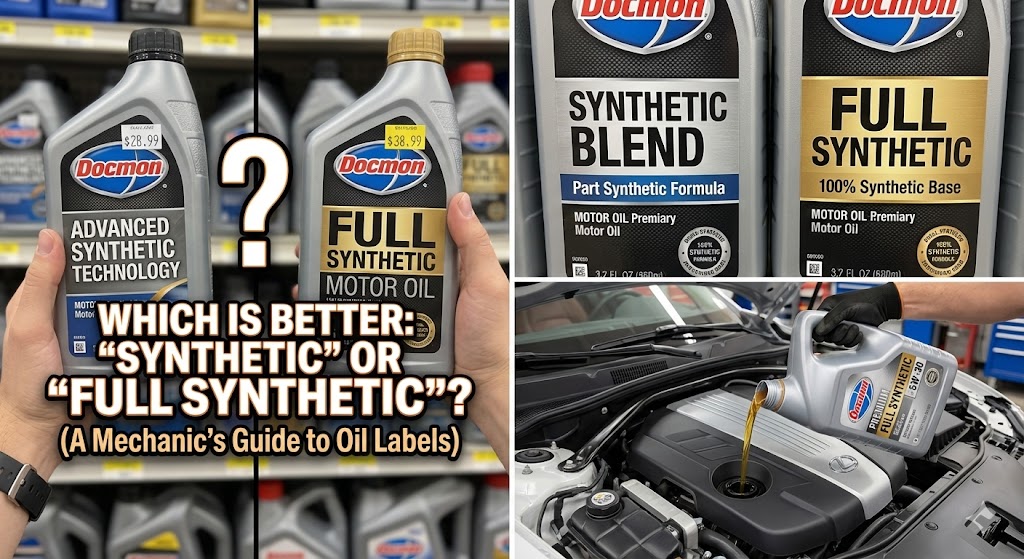
You are standing in aisle 7 of the auto parts store, staring at a wall of colorful plastic jugs. You know you need synthetic oil.
You pick up one bottle. The label says “Advanced Synthetic.” It’s $28. You pick up the bottle next to it. The label says “Full Synthetic.” It’s $38.
Wait a minute. Isn’t “synthetic” just… synthetic? Why is there a ten-dollar difference? Is the cheaper one fake? Is the expensive one a marketing scam?
As a mechanic, I see this confusion every day. In 2026, oil marketing departments have made labels incredibly confusing on purpose. Given how much a full synthetic oil change costs now, you need to know what you are actually buying.
Here is the honest truth about the difference between “Synthetic” and “Full Synthetic,” and which one your engine actually wants.
1. The Terminology Trap: What the Labels Actually Mean
This is the most important thing to understand: In the US market, if a bottle just says “Synthetic” without the word “Full” in front of it, it is almost certainly a Synthetic Blend.
They use tricky marketing terms like “Synthetic Technology,” “Synthetic Blend,” or “Semi-Synthetic.”
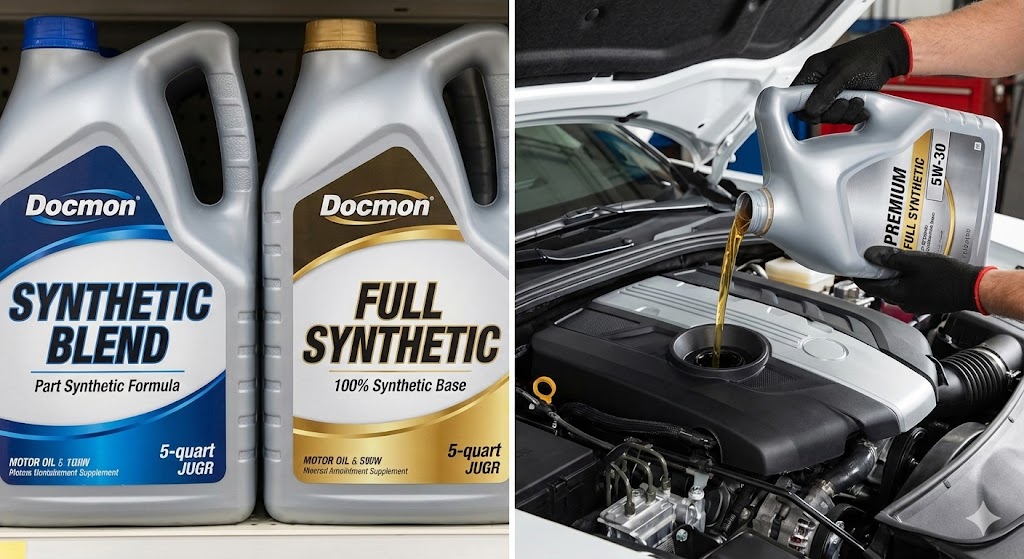
Synthetic Blend (The $28 bottle): This is a cocktail. It’s usually roughly 70% cheap conventional crude oil mixed with about 30% synthetic base stock. It’s better than pure conventional oil, but it still contains the impurities of dinosaur juice.
Full Synthetic (The $38 bottle): This oil uses a 100% synthetic base stock (usually highly processed Group III crude or lab-made Group IV PAO). It contains zero conventional oil.
Note: The legal definition of what constitutes “100% Synthetic” is complicated. I did a deep dive into the chemical reality in my article: Which motor oil is actually 100% synthetic? But for this comparison, “Full” means premium, and just “Synthetic” means blend.
2. The Showdown: Performance Differences
So, is Full Synthetic actually better than a Blend?
Yes. Absolutely. In every measurable way.
Because Full Synthetic doesn’t have the chaotic, impure molecules of conventional oil mixed in, it performs better at the extremes:
Extreme Heat: Blends will start to burn off and create sludge in a hot turbocharger much faster than Full Synthetic.
Extreme Cold: Full Synthetic flows much faster on a freezing morning, protecting your engine during those critical first seconds of startup.
Longevity: The additives in a Blend get used up faster trying to stabilize the conventional oil portion. Full Synthetic lasts longer, which is why engines last longer with synthetic oil.
WATCH: Synthetic Blend vs. Full Synthetic (Visual Test)
Don’t just take my word for it. This video visually demonstrates the difference in flow rate during cold temperatures between a blend and a full synthetic. The difference is shocking.
3. Is “Full” Worth the Extra Money?
This is where the rubber meets the road. The only real disadvantage of Full Synthetic oil is the price. It costs about $10-$15 more per oil change than a blend.
Is it worth it? In 2026, for almost every car, the answer is YES.
If you drive a modern car (anything made in the last 10-15 years), especially one with a turbo, direct injection, or stop-start technology, it was designed to run on Full Synthetic. Using a blend is a downgrade that can lead to long-term issues. Many modern vehicles are on the list of cars that actually need full synthetic oil.
Even if you have an older, high-mileage car, and you’re wondering when you should stop using full synthetic oil, the answer is usually “never,” because the extra protection is worth the small cost difference to keep that old engine running.
Ultimately, full synthetic oil is worth the extra cost because it’s cheap insurance against expensive engine repairs.
4. Dave’s Verdict: Stop Being Confused
Don’t let the marketing labels fool you.
“Synthetic Blend” (or just “Synthetic”) is a compromise. It’s okay for a budget beater, but it’s not the best.
“Full Synthetic” is the real deal. It provides the best protection, performance, and longevity.
When you ask “Which is better?”, there is no debate. Full Synthetic wins. Spend the extra ten bucks. Your engine deserves it.


