
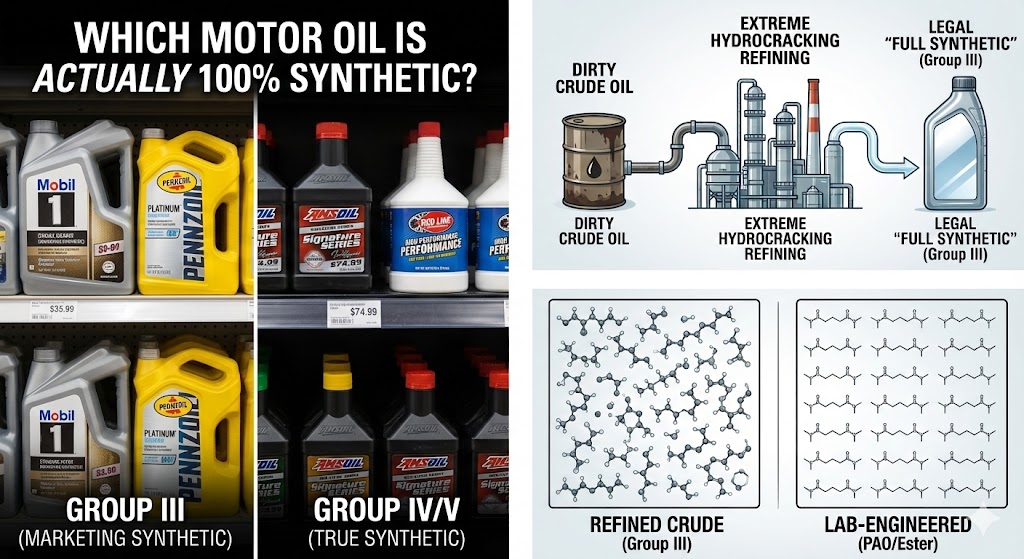
Imagine you are standing in the oil aisle at AutoZone. You see ten different shiny bottles. They all scream “FULL SYNTHETIC” in bold letters. Some even say “100% Synthetic.”
You grab the bottle of Mobil 1 or Valvoline. It costs $35 for a jug. Then you see a bottle of boutique oil like Amsoil or Red Line hidden on a bottom shelf, and it costs $75 for the same amount.
If they are both “100% Synthetic,” why is one double the price?
As a mechanic, I know that the term “Synthetic” on a label is one of the most confusing—and legally manipulated—terms in the automotive industry. Given how much a full synthetic oil change costs these days, you deserve to know what you are actually buying.
Here is the honest truth about what is really in that bottle, and which oils are truly, chemically, “100% synthetic.”
The Great Legal Loophole: When Crude Becomes “Synthetic”
To understand this, we have to go back to a famous legal battle in the late 1990s between Mobil 1 and Castrol.
Before that, “synthetic” meant oil meant it was engineered in a lab from the ground up, using specific chemical compounds (mostly Polyalphaolefins, or PAO). It had nothing to do with crude oil pumped from the ground.
Then, Castrol started taking highly refined crude oil, processing it intensely using a method called “hydrocracking,” and labeling it “Synthetic.” Mobil cried foul.
The ruling changed everything. The National Advertising Division (NAD) ruled that because the highly processed crude oil performed similarly to lab-made synthetic, it could legally be marketed as “Synthetic.”
The result in 2026: Today, about 90% of the “Full Synthetic” oil on store shelves (including most major brands like Pennzoil Platinum, Castrol Edge, and standard Mobil 1) are actually highly processed, super-clean crude oil.
In industry terms, these are called Group III base stocks. They are excellent oils, far better than conventional oil, but they are not chemically “100% synthetic” in the traditional sense.
So, What IS a “True” 100% Synthetic?
If you want oil that is truly engineered molecule-by-molecule in a lab, with zero crude oil lineage, you are looking for Group IV (PAO) and Group V (Esters) base stocks.
These oils are expensive to manufacture. Their molecules are perfectly uniform, like soldiers in exact formation, unlike refined crude oil molecules which are more like a chaotic crowd.
Why “True” Synthetics (Group IV/V) Are Better:
Extreme Cold Flow: They don’t rely on pour-point depressants that wear out. They flow freely at -40°F naturally.
Extreme Heat Resistance: They have unbelievably high “flash points” and resist burning off in screaming-hot turbos.
Longer Life: The base oil itself doesn’t break down as easily over time.
Who Actually Makes the Real Stuff in 2026?
If you want genuine Group IV/Group V synthetic oil, you usually have to leave the main aisle of Walmart and look at “boutique” brands.
These brands use high percentages of PAO and Esters. They are incredibly robust, but they carry a premium price tag that makes many drivers ask, “Is synthetic oil really worth the extra cost?”.
Examples of brands known for using “true” synthetic base stocks include:
Amsoil Signature Series (Famous for high PAO content)
Red Line High Performance (Famous for high Ester content)
Motul 300V (Racing-focused ester technology)
Certain top-tier European formulas from Liqui Moly or Ravenol designed for supercars.
Note: Even these brands sometimes blend in Group III oils for additive solubility, but their primary performance comes from true synthetic bases.
Dave’s Verdict: Does It Matter for YOUR Car?
This is the most important question. Do you need to spend $80 on Amsoil for your 2024 Toyota Camry commuter car?
Honestly? No.
For 99% of drivers doing normal commuting, towing, and road-tripping, the standard “Group III Full Synthetic” oils (like Pennzoil, Mobil 1, Valvoline) are phenomenal products. They are lightyears ahead of conventional oil and absolutely ensure that engines last longer. They meet all modern specs like API SP and dexos1 Gen 3.
You only need “True” PAO/Ester Synthetic if:
You track or race your car.
You live in extremely cold climates (Alaska, Northern Canada) where -30°F starts are common.
You have a high-end European performance car (BMW M, Porsche, AMG) that specifically calls for a boutique spec. (Check my list of which cars actually need specific synthetics).
The Bottom Line
Don’t get hung up on the “100%” marketing fluff on the front of the bottle. Look at the approvals on the back. If a standard $35 jug of synthetic meets your car’s required spec, it’s good enough to protect your engine for hundreds of thousands of miles.


