
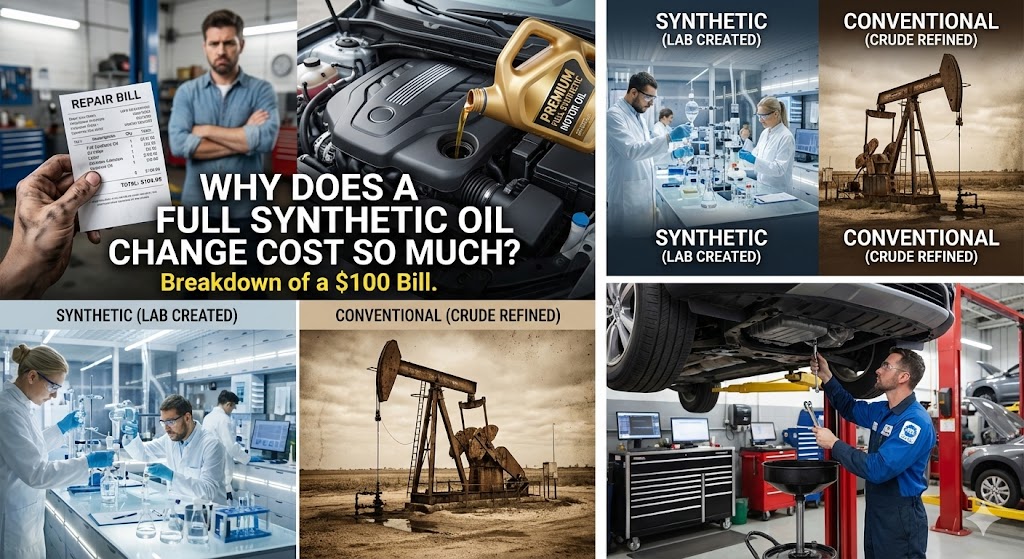
I see the look on your face when I hand you the bill across the service counter. You just wanted an oil change. It used to cost $30. Now, in 2026, the total for a full synthetic service is staring back at you: **$109.95**.
You feel ripped off. You think, “It’s just five quarts of liquid and a filter. How can that cost over a hundred bucks?”
I get it. It feels like highway robbery. But as the guy turning the wrench, let me take you behind the scenes and break down exactly where your money goes. It’s not just profit. It’s the cost of doing business in a high-tech, highly regulated world.
Here is the honest breakdown of a $100 synthetic oil change bill.
1. The “Liquid Gold”: Why Synthetic Costs More to Make
First, let’s talk about the materials themselves.
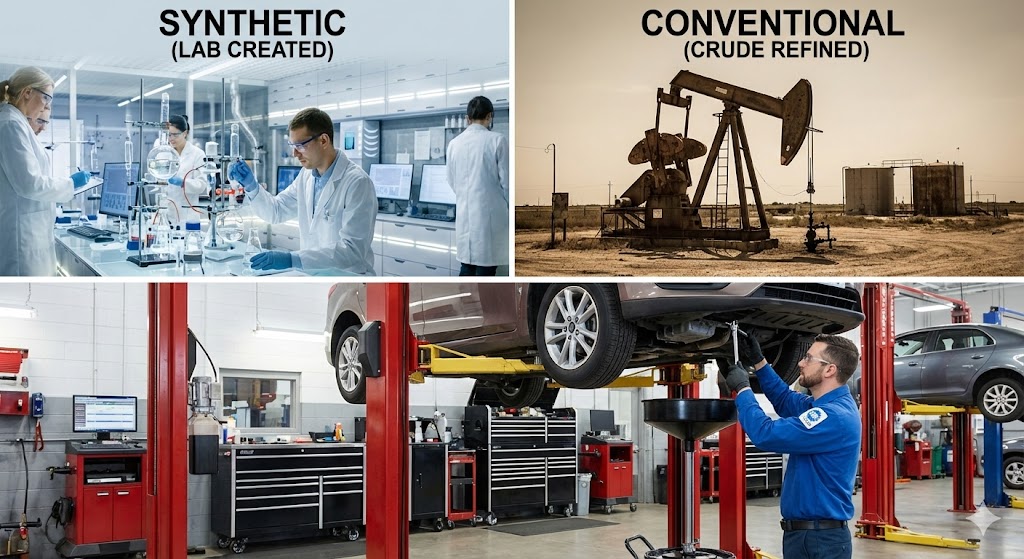
Conventional oil is basically refined crude oil dragged out of the ground. It’s cheap to process.
Full synthetic oil is completely different. It is a man-made chemical product engineered in a lab.
Complex Manufacturing: Scientists break down raw materials (like natural gas) into basic molecules and then rebuild them into uniform, perfect chains. This process is energy-intensive and expensive.
Expensive Additives: Modern engines require complex additive packages to fight low-speed pre-ignition (LSPI), protect turbos, and clean deposits. These patented chemical additives cost a fortune.
In 2026, a shop’s cost for 5 quarts of premium bulk synthetic oil and a high-quality filter is often around $45 – $55 just for the parts. We haven’t even touched the car yet.
2. The Shop’s Reality: Labor, Rent, and Tools
This is the part most people forget. You aren’t just buying oil; you are buying a professional service.
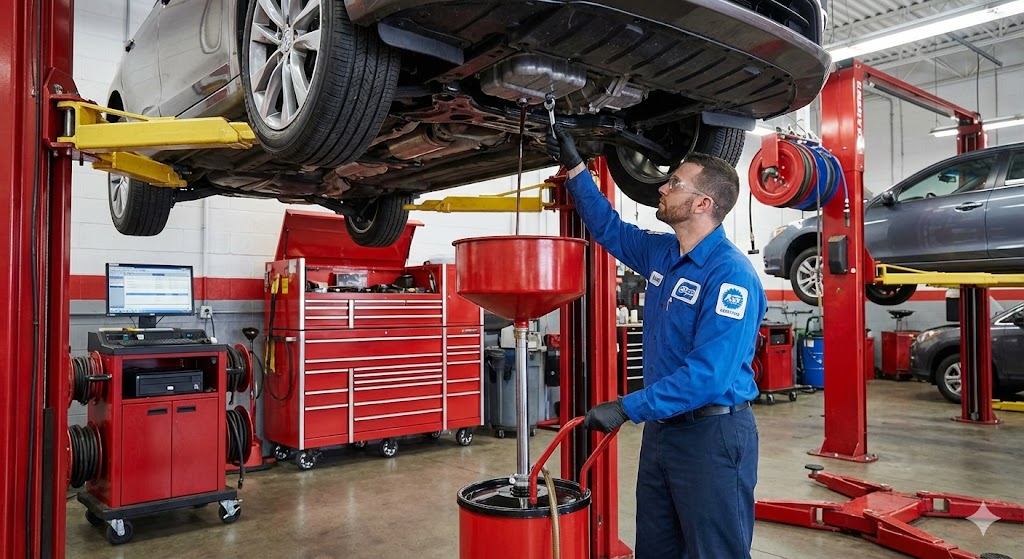
Skilled Labor: You don’t want the high school kid at the quick-lube place stripping your drain plug. You want a certified technician. In 2026, a good tech earns $40-$60 an hour. Even a “simple” oil change involves a multi-point inspection (checking tires, brakes, fluids) that takes 30-45 minutes of their time. Labor cost: ~$40.
Shop Overhead: The lights, heat, insurance, property taxes, software subscriptions for diagnostic tools, and the $20,000 hydraulic lift your car is sitting on all cost money. A shop’s hourly rate (e.g., $150/hr) has to cover all of this just to keep the doors open.
When you add labor and overhead to the parts cost, we are already at $85 – $95.
WATCH: Why Auto Repair Labor Rates Are So High
If you think shop owners are getting rich, watch this honest explanation of the immense costs involved in running a modern auto repair business.
3. The Hidden Fees: Disposal and Environment
We can’t just dump your 5 quarts of dirty, carcinogenic used oil down the drain.
EPA Regulations: We are strictly regulated on how we store and dispose of waste oil and old oil filters.
Disposal Fees: We have to pay licensed environmental service companies to come and collect this hazardous waste. This cost is passed on to you, usually as a “shop supply” or “environmental” fee on your bill.
Environmental fees: ~$5 – $10.
4. The Verdict: What Are You Really Paying For?
So, let’s tally up that $109.95 bill:
Premium Synthetic Oil & Filter: $50
Skilled Technician Labor & Inspection: $40
Shop Overhead & Tools: (Built into labor rate)
Environmental Disposal Fees: $10
Shop Profit: ~$10
A shop might make $10-$15 profit on an oil change. That’s it. It’s not a get-rich-quick scheme; it’s a low-margin service designed to build trust so you come back for the bigger repairs.
The next time you see that $100 bill, remember: You aren’t just paying for oil. You’re paying for the technology to protect your engine, the skill to do it right, and the responsibility to do it cleanly.


